

Disclosure: Some links below are affiliate links, meaning we may earn a small commission at no extra cost to you. Learn more.
Visiting the Phnom Penh Killing Fields and S21 is not a standard sightseeing activity. Entering Tuol Sleng or traveling to Choeung Ek demands heavy emotional investment, and feeling dread or hesitation before going is completely normal.
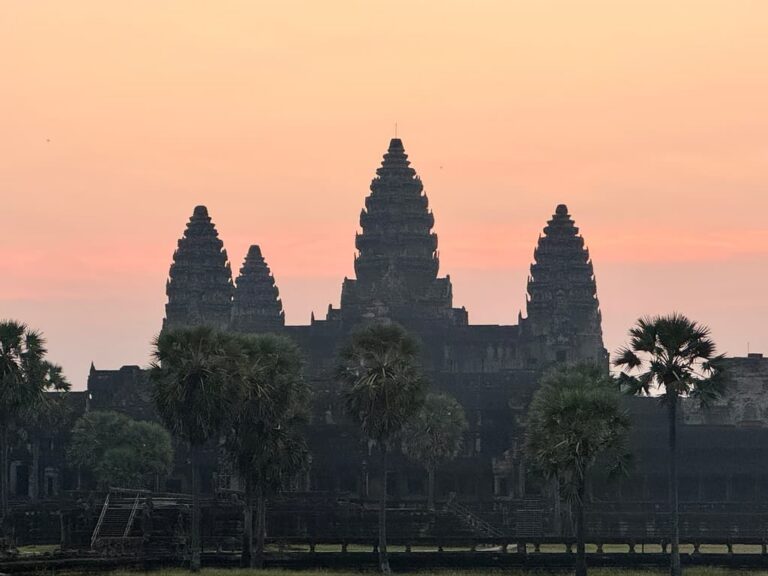
Relaxing on Koh Rong Samloem beaches or exploring the Angkor Wat temples reveals only one side of Cambodia. To truly understand the country, you must look at the scars of its recent past. If you’re wondering if Phnom Penh is worth visiting, these historical sites are what make the capital so deeply important.
This guide covers what to expect, how logistics work, and how to navigate these sites with respect. Bearing witness is vital to honoring the resilience of the Cambodian people and understanding modern Cambodia.
To handle transport and gain deeper context, we joined a guided excursion, and it made all the difference!
Best Killing Fields & S21 Tours
(Our Top Pick)

Our top recommendation is the Phnom Penh: The Killing Fields & Tuol Sleng Genocide Museum Tour.
Exploring with an expert guide provides accurate historical context and personal testimonies that you would miss otherwise.
We highly recommend it to everyone visiting Phnom Penh!
Historical Background: Phnom Penh Killing Fields and S21 Prison
Khmer Rouge Regime
Between 1975 and 1979, the Khmer Rouge regime led by Pol Pot imposed a radical agrarian revolution, turning Cambodia into a forced labor camp. To create a classless society, the regime emptied cities, abolished money, religion, and private property, while targeting intellectuals, monks, minorities, and anyone suspected of opposition.

By the time Phnom Penh was liberated in early 1979, an estimated 1.7 to 2 million people (nearly a quarter of Cambodia’s population) had died from execution, starvation, and exhaustion!
Connection Between the Two
Atrocities under the regime followed a systematic pipeline, with Tuol Sleng and Choeung Ek serving as two connected stages:
- Tuol Sleng (S-21 Prison): It was formerly a secondary school, and then became the regime’s primary secret interrogation center. Prisoners were interrogated, tortured, and forced into signing false confessions before being condemned.

- Choeung Ek (The Killing Fields): Once prisoners “confessed” at S-21, they were trucked to execution sites like Choeung Ek on the city outskirts, where mass graves were dug to dispose of the victims.

How to Visit the Phnom Penh Killing Fields & S-21 Prison: Tour vs DIY
Visiting independently means navigating the 15 km journey south to Choeung Ek, where return transport can be tricky to find. Joining a guided tour removes transport stress and provides deep historical context.
Below are the exact details and stops from the tour we took:
Why this route works: Starting at Choeung Ek and finishing at S-21 in the city center makes logistics easy. Ending centrally allows you to decompress and grab a meal near your hotel after an emotionally heavy morning.
What to Expect During Your Visit
Stop 1: Choeung Ek Genocidal Center (The Killing Fields)
After meeting our guide and group at the pick-up spot, our driver took us to the quiet memorial grounds of Choeung Ek (about 45 minutes south). The site is compact, so expect to spend about 1 to 1.5 hours here.
Our guide walked us through the grounds, highlighting key monuments and pointing out paths where fragments of clothing and bone still emerge from the earth after heavy rain.

The most prominent monument on the site is the towering Memorial Stupa, which houses thousands of recovered human skulls organized by age and gender.


One of the most heartbreaking locations is the Chankiri Tree (Killing Tree), where soldiers executed infants and children. While painful to see, it illustrates the brutal reality of the regime.

You will also see where chemical substances like DDT were stored—used to mask the odor of mass graves and kill any remaining survivors.
Hearing our guide share personal testimonies while standing on the grounds made the history unforgettable.
💡 Note for DIY Travelers: If you are visiting without a tour guide, make sure you rent the official audio guide at the entrance. It is essential for understanding the site.
Stop 2: Tuol Sleng Genocide Museum (S-21 Prison)
After Choeung Ek, we returned to central Phnom Penh for the final and most painful stop: the Tuol Sleng Genocide Museum (S-21 Prison).

Originally this building was the Tuol Svay Prey High School, but then was transformed into a high-security interrogation facility.
Anyone brought here was deemed an “enemy of the revolution”, including former government officials, teachers, foreigners, and eventually purged Khmer Rouge members.
Out of more than 18,000 documented prisoners, only 12 are known to have survived. Right near the entrance, you will see a memorial photo displaying the survivors who lived to tell their stories.

I warn you – walking through the former classrooms might feel a little haunting! Our guide led us through Building A, which houses the large iron bed frames and high-security cells used for interrogating high-ranking prisoners.
The former classrooms in Building B hold chilling evidence of what occurred here: rusted iron bed frames, heavy shackles, ammo boxes used as toilets, and brick partitions built to subdivide rooms into suffocating cells.

As you move through the blocks, you encounter signs marking historic details, such as the cell belonging to Chum Mey, one of the 8 adult survivors.


Other exhibits display floor-to-ceiling black-and-white photographs of men, women, and children taken upon arrival.

A particularly heartbreaking section of the museum documents the children of S-21.
Out of thousands of victims, only four children survived! They were found hiding beneath a pile of clothes when Vietnamese troops liberated the prison on January 7, 1979. My heart breaks for even writing about this!

During our visit, survivors Chum Mey and Bou Meng were on-site sharing their experiences.
Their lives were spared due to their skills: Bou Meng painted portraits of Pol Pot for propaganda, while Chum Mey repaired sewing machines and typewriters.

If you want to hear the voices of Bou Meng and Chun Mey, check out the documentary S21 The Khmer Rouge Killing Machine. It was shot in S-21 prison, and it is a blood chilling recount of the events through the words of the former survivors, and the former guards.
💡 Note for DIY Travelers: If you are visiting without a tour guide, make sure you rent the audio guide at the entrance ($5.00 for non Cambodian languages), as it provides crucial narrative depth for every room and exhibit.
Essential Practical Tips for Your Visit
- Recommended Route: Visit Choeung Ek (Killing Fields) in the morning and S-21 (Tuol Sleng) in the afternoon. Ending centrally in Phnom Penh makes it easier to decompress, grab a meal, and head back to your hotel.
- Transport & Logistics: Joining an organized tour is the most seamless option. If you travel independently, hire a Grab tuk-tuk for a half-day return trip.
- Strict Dress Code: Out of respect for the victims, shoulders and knees must be covered at both sites (no tank tops or short shorts).
- Audio Guides: If visiting independently, purchase the official audio guide at both entrances. They are essential for understanding the history.
- Etiquette & Photography: Maintain a quiet demeanor. Photography is prohibited in sensitive interior exhibits.
- Emotional Preparation: Give yourself plenty of mental space to process the heavy atmosphere. This won’t be easy but it is totally worth it.

Final Thoughts: Is the Phnom Penh Killing Fields and S21 Prison Worth It?
Visiting the Choeung Ek Genocidal Center and the Tuol Sleng Genocide Museum is undeniably heavy, but it is one of the most vital travel experiences in Cambodia.
Confronting this recent history firsthand will give you an appreciation for the resilience of the Cambodian people. It is an emotionally draining day, but bearing witness to these dark chapters ensures that the victims are never forgotten!
To remove transport hassles and ensure you receive full historical context, we highly recommend booking the same guided tour we took.
Frequently Asked Questions (FAQs)
You need approximately 4 to 5 hours for both sites. Expect to spend 1 to 1.5 hours at Choeung Ek, 1.5 to 2 hours at S-21 Prison, plus travel time between the two locations.
Entrance to Choeung Ek (The Killing Fields) is $3 (or $6 with audio guide). Entrance to Tuol Sleng (S-21) is $5 (or $10 with audio guide).
Definitely, but be ready as both sites are emotionally intense.
S-21 focuses on the interrogation and prison conditions, while Choeung Ek displays the execution grounds and mass graves. Visiting both together offers a complete historical picture on Cambodia.
S-21 Prison is located in central Phnom Penh, while Choeung Ek is about 15 km south. The easiest options are joining a guided tour or hiring a Grab tuk-tuk driver to take you to both sites and wait for you.
⏰ Planning the rest of your trip? Don’t miss our other Cambodia guides:
- How to Spend 2 days in Koh Rong Samloem: Ultimate Beach Guide
- Saracen Bay Accommodation Guide: Best Places to Stay in Koh Rong Samloem
- Why a 2-Day Angkor Wat Tour is Worth Every Penny
- Cambodia Transport Guide
- Siem Reap Beyond Angkor Wat
- Is Phnom Penh Worth Visiting?
- Phnom Penh Killing Fields and S21
- How to Spend 10 Days in Cambodia